


Last updated: November 2026 (reflects ABP 2027 Exam Content)
Author: Ashish Goyal, MD
Introduction
Need a complete guide to the 2027 MOCA-Peds exam?
Quick Links (Jump to Section)
- Quick Reference: 2027 MOCA-Peds at a Glance
- Download the One-Page Checklist (Fastest Way to Stay Organized)
- About the 2027 MOCA-Peds Learning Objectives and Featured Readings
- How PBR Helps Pediatricians Navigate MOCA-Peds in 2027
- 2027 vs. 2026: What’s New in MOCA-Peds
- 2027 MOCA-Peds General Pediatrics Learning Objectives (Complete List)
- MOCA-Peds Featured Readings 2027
- How MOCA-Peds Tests the 2027 Learning Objectives
- My Pro Tips for MOCA-Peds Questions in 2027
- How to Study the 2027 MOCA-Peds Learning Objectives
- Why Choose MOCA-PBR for 2027?
- OPTIONAL: Free MOCA-Peds Resources and Next Steps
- FAQs
You’re in the right place. This page includes:
- The ABP-published learning objectives for 2027. The ABP still lists these objectives as preliminary. We’ll update this page when the final list is published.
- Both preliminary 2027 featured readings with direct links
- A printable 1-page checklist to help you stay organized
- Quick study guidance (so you don’t waste time)
I’m Dr. Ashish Goyal, board-certified pediatrician and founder of Pediatrics Board Review (PBR). Since 2011, I’ve helped thousands of pediatricians prepare for board certification and navigate MOCA-Peds.
Quick Reference: 2027 MOCA-Peds at a Glance
- Number of 2027 General Pediatrics learning objectives: 49.
- Number of 2026 General Pediatrics learning objectives: 45. The 2027 list contains four more overall.
- What MOCA-Peds is: the Maintenance of Certification Assessment for Pediatrics, the longitudinal knowledge assessment used for continuing certification.
- Official source: American Board of Pediatrics 2027 MOCA-Peds Exam Content.

Download the One-Page Checklist (Fastest Way to Stay Organized)
Most pediatricians searching this phrase want to save the learning objectives list quickly and move on.
The checklist is built for quick weekly use. Mark your weakest topics first, aim for about four learning objectives per week, and keep a separate check on the featured readings so they do not get lost later in the year.
Print-friendly, grouped by week, with checkboxes for quick weekly tracking.
About the 2027 MOCA-Peds Learning Objectives and Featured Readings
The 2027 MOCA-Peds learning objectives and featured readings are the annual content framework published for MOCA-Peds preparation. For General Pediatrics, the 2027 release contains 49 learning objectives.
Here’s what the annual release itself contains:
- 49 General Pediatrics learning objectives that define which clinical areas may be assessed during the 2027 cycle.
- A featured-reading set that ties the assessment to current guidelines and standards of care.
- Advance notice, because the content is published before the assessment year begins, so you can review unfamiliar topics early.
And here’s how the assessment uses that content during the year:
- Up to 20 timed questions each quarter, drawn from those objectives and readings.
- Feedback after every question, including the rationale for the correct answer and supporting references.
Treat the learning objective list as a content roadmap, not a promise that every learning objective will appear. The approach that works best is to:
- Identify unfamiliar or weak areas first, before your Quarter 1 questions open.
- Go through the learning objectives list at a steady weekly pace instead of clearing it in one sitting.
- Use the featured readings and your question feedback to refine what you review as the year progresses.
How PBR Helps Pediatricians Navigate MOCA-Peds in 2027
In 2018, I became the first person in the country to create a study guide for MOCA-Peds. Every year since then, when the ABP releases its learning objectives and featured readings, I begin developing comprehensive content for each topic.
I aim to create topic summaries that are no more than three to five pages long. These summaries include the highest-yield and most testable content, guided by years of experience helping thousands of pediatricians attain and maintain board certification.
The results have been tremendous and are deeply appreciated by the general pediatrician community. It is rewarding to not only deepen my own understanding of the current world of pediatrics but also to support other pediatricians. I believe so strongly in your ability to succeed with the MOCA-PBR Study Guide & Test Companion that I offer a quarterly pass money-back guarantee.

2027 vs. 2026: What’s New in MOCA-Peds
The General Pediatrics objective list grows from 45 in 2026 to 49 in 2027, but a larger number doesn’t mean that four topics were simply added. Some objectives were retained, some were removed, and others were combined or reworded.

Here’s how to use that:
- Use the new ABP release as your source of truth. Don’t assume that every 2026 objective carries forward unchanged.
- Prioritize objectives that are unfamiliar, rarely seen in your practice, or clearly reworded from last year.
- Lean on the remaining objectives to reinforce high-frequency clinical decision-making rather than memorizing isolated facts.
- Treat this comparison as provisional until the ABP publishes the final 2027 learning objectives list.
Topic Areas That Are New or Expanded in the 2027 List
| Category | New or expanded in the 2027 list |
|---|---|
| Acute and high-stakes care | Impending respiratory failure and ventilatory support |
| Infectious disease | Sexually transmitted infections |
| Abuse and safety | Psychological abuse |
| Mental and behavioral health | PTSD, OCD, and ODD-type presentations |
| Mental and behavioral health | Mental health and psychosocial screening |
| Systems-based practice | Quality improvement methods |
| Adolescent and transition care | Transition to adult care |
| Oncology and hematology | Hematologic and musculoskeletal malignancy differentials |
| Systemic and inflammatory disease | Vasculitis and MIS-C |
| Cardiology | Cardiomyopathies |
| Endocrinology | Type 1 diabetes |
| Neurology and genetics | Neurocutaneous syndromes |
| Genetics | Common numerical chromosome abnormalities |
| Developmental surveillance | Age bands shift from the 2026 newborn and preschool bands to 3 to 6 month and 5 to 10 year bands |
2027 MOCA-Peds General Pediatrics Learning Objectives (Complete List)
Use the complete official list below as your study roadmap, and mark any objective that is unfamiliar, rarely encountered in your practice, or meaningfully different from the 2026 content.
Official source: 2027 MOCA-Peds Exam Content (ABP). The ABP still lists these objectives as preliminary and will publish a final list. It’s safe to start studying from this list now, because the annual objectives rarely change wholesale, and we’ll update this page when the final list is published.
- Apply effective communication strategies when delivering difficult news, establishing goals of care, or planning advanced or end-of-life care.
- Counsel patients and families about safety and injury prevention pertaining to school-age children (eg, helmet use, gun safety).
- Evaluate and manage an infant with prenatally diagnosed fetal conditions (eg, hydronephrosis).
- Evaluate and manage congenital and hereditary orthopedic disorders.
- Evaluate and manage patients with non-orthopedic sports medicine conditions and injuries (eg, exertional heat illness, concussion).
- Provide counseling and prophylaxis for infectious diseases prior to international travel and the evaluation of potential infectious diseases resulting from travel.
- Recognize and manage a patient with impending respiratory failure, including appropriate ventilatory support.
- Recognize psychological disorders with significant behavioral manifestations (eg, post-traumatic stress disorder, obsessive-compulsive disorder, oppositional defiant disorder, conduct disorder, delinquency, antisocial).
- Recognize the clinical presentation, evaluate, and manage sexually transmitted infections.
- Recognize the signs and understand the impact of psychological abuse on children.
- Recognize, evaluate, and manage both normal and atypical growth and development of a 3- to 6-month-old infant (eg, physical, social, emotional, language, gross motor, and fine motor).
- Recognize, evaluate, and manage both normal and atypical growth and development of a 5- to 10-year-old child (eg, physical, social, emotional, language, gross motor, and fine motor).
- Recognize, evaluate, and manage respiratory distress in children of different ages.
- Recognize, evaluate, and manage symptoms related to diseases of the oral cavity.
- Recognize, evaluate, and treat genitourinary system injuries resulting from trauma.
- Understand and apply quality improvement methods.
- Understand and manage adolescents’ transition to adult care.
- Understand and manage age-appropriate mental health and psychosocial screenings (eg, autism, depression, anxiety, and suicide screening).
- Understand the clinical presentation, diagnosis, and management of common parasitic infections.
- Understand the clinical presentation, differential diagnosis, and evaluation of hematologic and lymphatic malignancies.
- Understand the clinical presentation, differential diagnosis, and evaluation of musculoskeletal malignancies.
- Understand the clinical presentation, differential diagnosis, evaluation, and management of celiac disease.
- Understand the clinical presentation, differential diagnosis, evaluation, and management of noninfectious rashes in a neonate.
- Understand the diagnosis, evaluation, and management of vasculitis (eg, multisystem inflammatory syndrome in children [MIS-C], Kawasaki disease).
- Understand the differential diagnosis, evaluation, and initial management of neonates presenting with gastrointestinal symptoms.
- Understand the differential diagnosis, evaluation, and management of acute and chronic urticaria.
- Understand the differential diagnosis, evaluation, and management of dysfunctional nephrology disorders, diseases, and conditions.
- Understand the differential diagnosis, evaluation, and management of menstrual disorders and conditions (eg, dysmenorrhea, menorrhagia, polycystic ovary syndrome).
- Understand the differential diagnosis, evaluation, and management of various conditions that present with learning differences in childhood.
- Understand the differential diagnosis, evaluation, and treatment of patients presenting with weakness or other symptoms of a peripheral nervous system disorder (eg, neuropathies, neuromuscular junction disorders, toxins).
- Understand the differential diagnosis, evaluations, and initial management of sexual abuse and assault in children of different ages.
- Understand the differential diagnosis, presentation, and management of intermittent upper airway obstruction (eg, laryngomalacia, tracheomalacia, vocal cord dysfunction).
- Understand the evaluation, diagnosis, and management of cardiomyopathies.
- Understand the impact, prevention, and management of adverse childhood experiences.
- Understand the presentation, differential diagnosis, and management of asthma, including status asthmaticus.
- Understand the presentation, differential diagnosis, evaluation, and initial management of postinfectious/reactive arthritis (eg, post-streptococcal, enteric infections, Epstein-Barr virus).
- Understand the presentation, differential diagnosis, evaluation, and management of dermatologic papules, nodules, and cysts.
- Understand the presentation, differential diagnosis, evaluation, and management of type 1 diabetes.
- Understand the presentation, differential diagnosis, evaluation, and treatment of neurocutaneous syndromes.
- Understand the presentation, evaluation, and care of patients with common numerical chromosome abnormalities (eg, trisomies).
- Understand, evaluate, and manage chronic lung disease related to prematurity (bronchopulmonary dysplasia).
- Understand, evaluate, and manage common behavioral issues (eg, eating, sleeping, toilet training, aggression/acting out, discipline) at different ages.
- Understand, evaluate, and manage condition-specific nutritional needs (eg, food allergies, hypertension).
- Understand, evaluate, and manage cyanotic congenital heart disease.
- Understand, evaluate, and manage inflammatory/infectious diseases, disorders, and conditions of the mouth, oropharynx, and throat.
- Understand, evaluate, and manage issues related to violence and bullying.
- Understand, evaluate, and manage specific health care needs related to sexual orientation in an adolescent.
- Understand, evaluate, and manage structural/anatomic diseases, disorders, and conditions of the nose and sinuses.
- Understand, evaluate, and manage trauma/injury of the neck.
MOCA-Peds Featured Readings 2027
Featured readings connect MOCA-Peds to current guidelines and standards of care. There were 4 featured readings in 2026. The ABP has now published its preliminary featured reading selections for 2027. Two articles are listed so far, both from Pediatrics. The ABP still lists them as preliminary, so treat the two below as provisional until the final set is published. We’ll update this page if more are added.
Preliminary 2027 Featured Readings
Rodan LH, Stoler J, Chen E, Geleske T. Pediatrics. 2025 Jul 1;156(1). doi: 10.1542/peds.2025-072219.
Journal (full text)Stefater-Richards MA, Jhe G, Zhang YJ. Pediatrics. 2025 Apr 1;155(4). doi: 10.1542/peds.2024-068119.
Journal (DOI) | PubMedFind it here: Preliminary MOCA-Peds Featured Reading Selections for 2027
Up to two questions can appear for each featured reading, and featured-reading questions begin in Quarter 2 and can appear in later quarters, so it’s worth saving both articles early even if you don’t plan to study them right away.
In MOCA-PBR, I summarize the featured readings into high-yield clinical takeaways so you are reviewing what is most likely to be tested rather than rereading full guidelines under time pressure. You can see how that works in the MOCA-PBR Study Guide & Test Companion.
How MOCA-Peds Tests the 2027 Learning Objectives
The 2027 objective list tells you what content may be assessed, but knowing the topic alone isn’t enough. MOCA-Peds questions are built around real clinical decisions such as recognizing the problem, identifying the detail that changes risk or management, and choosing the best next step in order.
Keep the same three patterns in mind throughout your 2027 preparation.
Pattern 1: The “best NEXT step” beats trivia
MOCA-Peds questions reward recognition: what to do first, what to do next, and when to escalate care. Instead of focusing on rare facts, focus on clinical reasoning.
- Which diagnosis is most likely?
- Which step changes management today?
- What would be unsafe to miss?
Pattern 2: One detail changes the answer
Many questions include a single key detail that flips the correct choice. Common pivot points include:
- Age cutoffs, such as newborn versus infant versus adolescent
- Red flags and warning signs
- Severity clues, such as toxic appearance, instability, or dehydration
- Risk stratification between higher-risk and lower-risk patients
- Safety and reporting decisions, including abuse, neglect, and patient-safety events
Pattern 3: Speed still matters in an open-book format
MOCA-Peds allows you to use references, but the clock still runs. The goal isn’t to look up everything. It’s to confirm what you already suspect. Before a session, know:
- What you already understand confidently
- What you should quickly verify
- What isn’t worth chasing during a timed question
The fastest answers come from recognizing the pattern first, then using your resources to confirm the detail rather than starting from scratch.
My Pro Tips for MOCA-Peds Questions in 2027
Plan ahead
Start by scanning all 49 General Pediatrics learning objectives. If you studied from the 2026 list, review the 2027 versus 2026 changes first so you know where fresh review is most useful.
Study in small weekly wins
Aim for about four learning objectives per week. With 49 objectives, that creates a practical 12 to 13 week first pass through the General Pediatrics list without a last-minute rush at the end of the quarter.
Use MOCA-Peds as a learning tool
Pay close attention to questions you answered with high confidence but still missed. Those misses often reveal a misconception or an outdated clinical assumption, and they can be far more valuable than a question you already knew you were unsure about.
Do not ignore the featured readings
The two preliminary 2027 featured readings are already published, so save them now rather than later, and return to the official ABP source once the final set is confirmed.
Prepare your reference workflow before a timed session
Know which trusted resources you’ll use before the clock starts. The goal isn’t to research every answer from scratch. It’s to recognize the clinical pattern, then verify the detail that changes management.
How to Study the 2027 MOCA-Peds Learning Objectives
- Start with the 2027 versus 2026 comparison and flag any objective that deserves fresh attention.
- Download the 2027 checklist and mark your 10 weakest General Pediatrics objectives.
- Review about four learning objectives per week. At that pace, you can complete a first pass through all 49 objectives in roughly 12 to 13 weeks.
- Save the two preliminary featured readings now, and confirm the final 2027 reading set once the ABP publishes it.
- Before each new quarterly session, revisit high-confidence misses and the explanations from previous questions.

Why Choose MOCA-PBR for 2027?

For me, MOCA-Peds represents the future of meaningful professional growth.
It’s not just about answering questions correctly…it’s about staying sharp, staying current, and protecting a standard of care delivered to children and families.
The challenge is that MOCA-Peds can feel overwhelming in real life. The learning objectives are provided in advance, but are broad. The questions are timed, and the “best answer” often depends on one clinical detail.
Most pediatricians don’t struggle because they aren’t smart.
They struggle because they don’t have a streamlined system to study curated, testable information, or they resort to panicked online searches.
That’s exactly why I created MOCA-PBR.
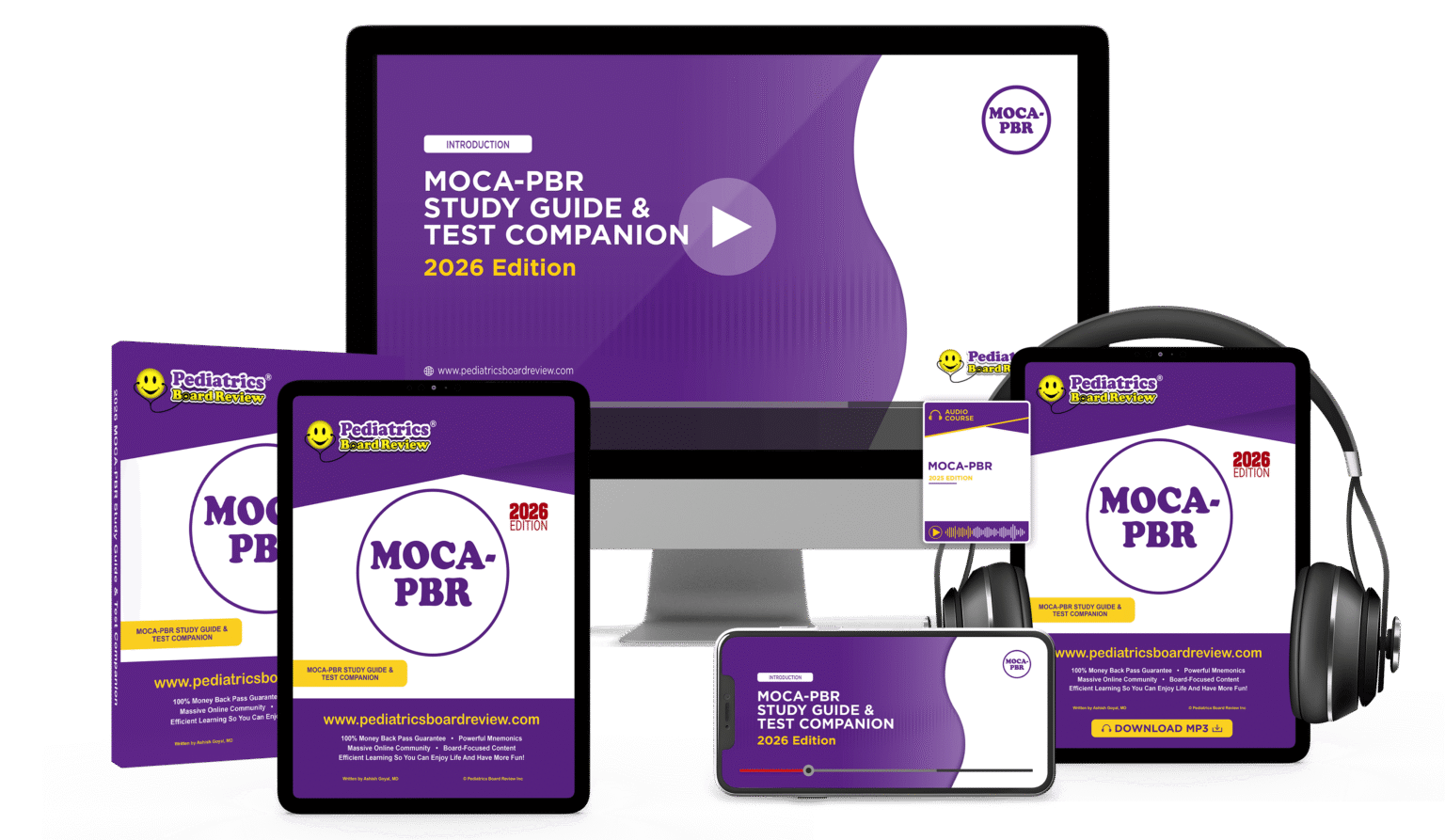
With the MOCA-PBR Study Guide & Test Companion and a Quick Search Feature, you can approach MOCA-Peds with more confidence, less stress, and a clearer plan, quarter by quarter.
Stop guessing and start preparing with structure. Explore MOCA-PBR and let Team PBR be your partner in success.
Have questions? My team is happy to help you choose the right path for your situation.
OPTIONAL: Free MOCA-Peds Resources and Next Steps
Want Free MOCA-Peds Topic Summaries?
These summaries are from the 2026 cycle and show the format. The 2027 summaries will be added once the ABP finalizes its list.
Download these free high-yield MOCA-Peds topic summaries (PDFs):
- Allergic Rhinitis: Differential Diagnosis, Evaluation, and Management
- Ankyloglossia: Identification and Management (and its effect on breastfeeding in infants)
- Child Abuse (Physical): Recognize and Evaluate Findings of Physical Child Abuse and Distinguish from Accidental Trauma
- Diabetic Ketoacidosis: Recognize and Plan the Management of a Child with Diabetic Ketoacidosis
- Mycobacterial Infections: Clinical Presentation, Diagnosis, and Management of Common Mycobacterial Infections
How to Use the Free Summaries
Want to start with a few focused topics before going through the full 2027 list? Here is a simple order to follow:
- Download the free topic summaries above and begin with the areas where you feel least confident.
- Use them to see how a PBR topic summary is structured before the 2027 set is released.
- Once the final 2027 list is published, re-check your weak areas against it before you build the rest of the year around them.
- If you are claiming credit this cycle, earn CME credits and MOC points from the same review work.
Get the Free MOCA-Peds Topic Summaries
Use MOCA-PBR to build a steady quarter-by-quarter study routine, reduce frantic searching, and approach the 2027 MOCA-Peds questions with a clearer plan. Every quarter is backed by the MOCA-PBR Quarterly Pass Guarantee when you complete the ABP-assigned questions. Terms apply.
FAQs
1. How many learning objectives are in MOCA-Peds 2027?
The 2027 General Pediatrics MOCA-Peds cycle includes 49 learning objectives. The 2026 list contained 45, so the annual General Pediatrics list is larger in 2027.
2. What changed between the 2026 and 2027 MOCA-Peds learning objectives?
The confirmed overall change is an increase from 45 General Pediatrics objectives in 2026 to 49 in 2027. Because annual objectives can be retained, removed, split, combined, or reworded, use the official 2027 ABP list as your current roadmap and review the comparison section before relying on last year’s study plan.
3. What are the 2027 MOCA-Peds featured readings?
The ABP has published two preliminary featured reading selections for 2027: the AAP clinical report on genetic evaluation of the child with intellectual disability or global developmental delay, and a Pediatrics review on GLP-1 receptor agonists in pediatric and adolescent obesity. Both are linked in the featured readings section above. The ABP still lists them as preliminary, and we’ll update this page when the final set is published.
4. When do featured-reading questions appear in MOCA-Peds?
Featured-reading questions begin in Quarter 2 and may continue in later quarters. Bookmark the readings early so you are not trying to find long source documents for the first time during a timed session. More answers to common questions are in our MOCA-Peds FAQ guide.
5. What is the MOCA-Peds passing score?
MOCA-Peds uses a scaled score, and the commonly published passing standard is 180 on a 1 to 300 scale. You can review the official details on the ABP MOCA-Peds scoring page. Your dashboard and annual performance feedback are more useful than trying to convert a single quarter’s raw percentage directly into the final scaled score.
6. How should I study for MOCA-Peds 2027?
Start with the 2027 versus 2026 changes, identify your weakest objectives, and review about four learning objectives per week. Track high-confidence misses, bookmark the featured readings, and use trusted references to verify details in order rather than researching every question from scratch.
7. Do I need to memorize all 49 objectives?
No. Use the 49 objectives as a roadmap for what to review. Focus first on unfamiliar topics, clinical decisions you don’t make often, and objectives where a small change in age, severity, risk, or management could change the best answer.
8. Are all 49 objectives certain to be tested in 2027?
No. The annual learning objectives define the content scope, but the presence of a learning objective on the list doesn’t mean every participant will receive a question on every objective.
9. Are the 2027 MOCA-Peds topic summaries available yet?
Not yet. PBR builds each year’s topic summaries after the ABP confirms its final objective list, which hasn’t been published yet. Writing them earlier would mean writing against objectives that may still be reworded, combined, or removed. Until the 2027 set is released, the free MOCA-PBR topic summaries linked in the resources section of this page are available now.
10. What does a MOCA-PBR topic summary actually look like?
Each summary is built around one ABP learning objective and walks through the topic in a consistent order: background, clinical features, differential diagnosis, evaluation and diagnosis, management and treatment, complications, and counseling and prevention. A jump-to-section menu at the top lets you move straight to the part you need during a timed question. The free topic summaries linked on this page show the format.
About the Author
Ashish Goyal, MD is a board-certified pediatrician and the founder of Pediatrics Board Review. He has helped pediatricians prepare for American Board of Pediatrics certification since 2011, wrote the first MOCA-Peds study guide in the country in 2018, and has rebuilt it every cycle around the objectives and featured readings the ABP publishes for that year. Every MOCA-PBR quarter is backed by a pass guarantee.