

If you’re getting ready for the pediatric board exam, you probably have a lot of questions running through your head right now. I know I did.
When I was preparing for the ABP exam, I thought I had it figured out. I didn’t. I failed my first attempt and that experience changed everything about how I approached board prep. It’s also what eventually led me to build a Pediatrics Board Review. This guide is everything I wish someone had handed me before I sat for that exam.
We’ll walk through the exam structure, eligibility requirements, scoring, preparation strategy, and the most common mistakes candidates make. More importantly, I’ll tell you how to approach this exam efficiently the way the ABP actually evaluates you so you’re not wasting time guessing.
An Executive Overview of the Pediatric Board Exam
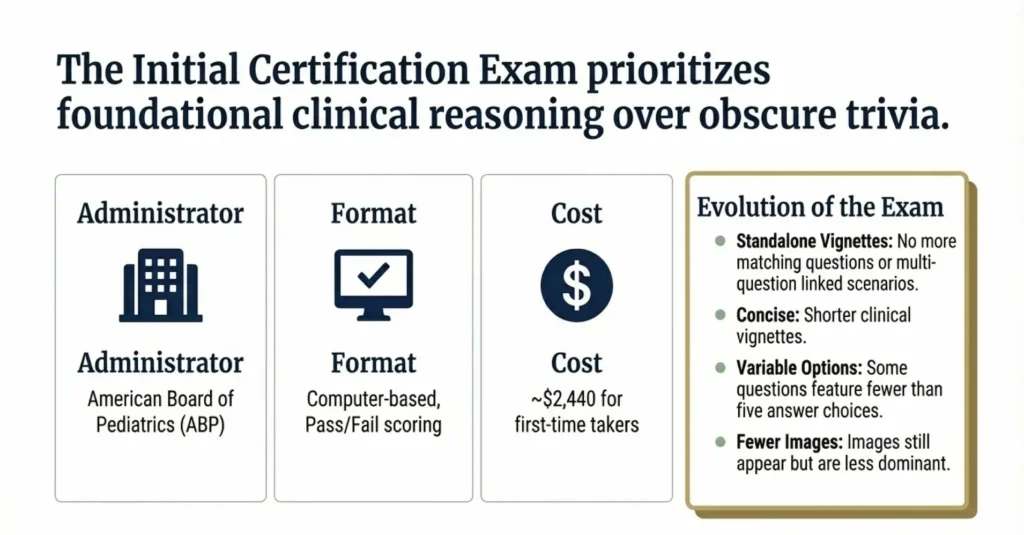
The pediatric board exam is the Initial Certification Exam (ICE) administered by the American Board of Pediatrics (ABP). It’s the final step in the training pathway for general pediatricians who’ve completed accredited residency training.
At a high level, the exam:
- Is computer based
- Is delivered in four separate testing blocks
- Covers a wide range of pediatric clinical domains
- Uses multiple choice, single best answer questions
- Is scored on a pass/fail basis
The purpose of the exam isn’t to test obscure trivia. It evaluates whether a pediatrician has the foundational knowledge required to practice safely and independently across the breadth of general pediatrics.
For most of us, this is the biggest professional milestone since finishing residency. It’s the moment that separates ‘almost there’ from ‘board certified pediatrician.’ And yeah, it carries weight.
Pediatric Board Exam: Time Per Question, Number of Blocks & Total Exam Length
The pediatric board exam is divided into four timed testing blocks, all administered in a single exam day. Here’s the math:
- Four separate testing blocks (A, B, C, D)
- Approximately 84 questions per block
- 1 hour 45 minutes per block
- Total question count: approximately 330–350 questions
- Total exam day: approximately 8.5–9 hours including breaks
Approximate Time Per Question
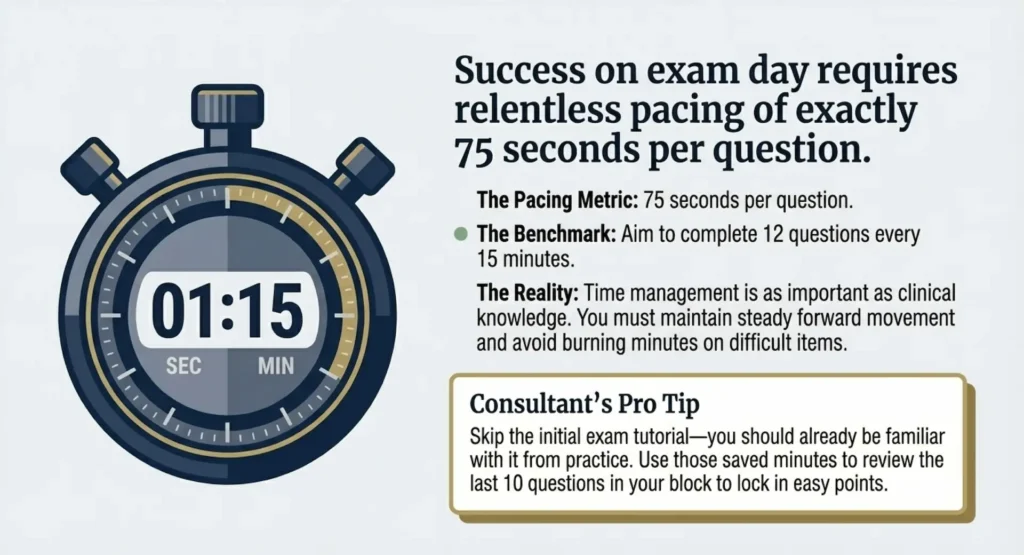
You’ll have roughly 75 seconds per question. A good pacing target: aim for 12 questions every 15 minutes. It sounds manageable until you hit a question that stops you cold and you’ve burned 3 minutes without realizing it.
This Means:
- You can’t dwell excessively on difficult items
- You must maintain steady forward movement
- Time management is as important as knowledge
Training under timed conditions is essential. Answering board style questions efficiently is a skill that must be practiced deliberately, it’s different from simply knowing pediatrics.
Pro tip: During the actual exam, skip the tutorial you’ve already practiced. Use that time to check the last 10 questions in your block for any easy ones you can lock in quickly.
For a full breakdown of pacing strategy and test day tips, check out our detailed post: Managing Your Time Per Question on the ABP Exam.|
What Does Board Certification Really Mean?
Board certification carries meaning on two levels: institutional and personal.
Institutional Meaning
From the ABP’s perspective, board certification confirms that a pediatrician meets nationally recognized standards of knowledge and competency. It supports:
- Public trust in pediatric care
- Consistency of clinical standards
- Professional accountability
- A structured pathway for lifelong learning
Board certification is part of a larger system that ensures pediatricians stay current and qualified throughout their careers.
Personal Meaning
Here’s what I can tell you from personal experience: the weight of finally having those letters after your name is something you carry differently than you expect. It’s not just a credential it’s the formal moment where years of training click into something real. It’s validation you’ve earned.
Board certification supports:
- Professional credibility among peers and institutions
- Increased confidence in independent clinical decision making
- Greater career mobility and leadership opportunities
- Long term trust from patients, families, and healthcare systems
Practical Benefits of Board Certification
1. Employment Requirements
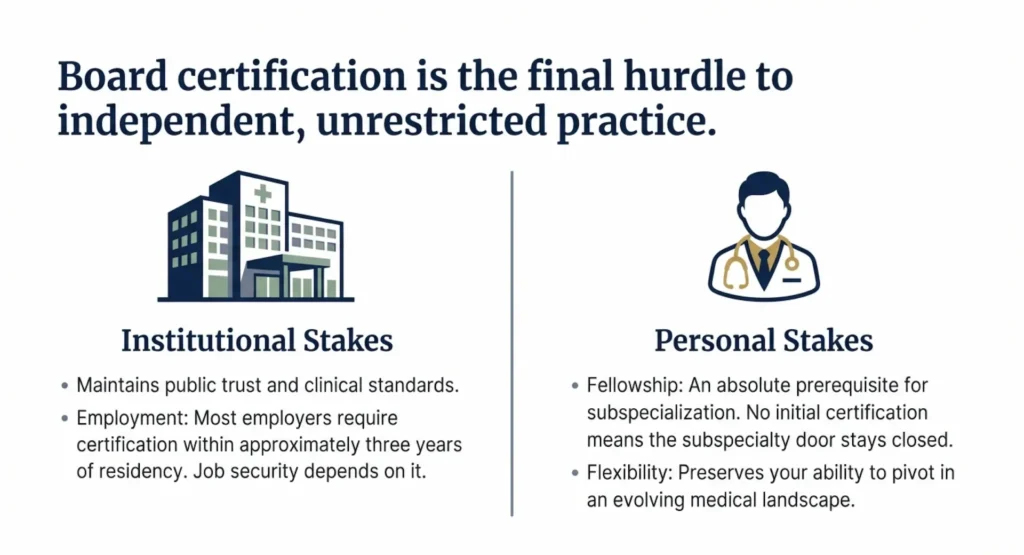
Most employers require pediatricians to become board certified within approximately three years of completing residency. Failure to do so can jeopardize job security full stop.
2. Fellowship and Subspecialization
Board certification in general pediatrics is an absolute prerequisite for fellowship training and for sitting for any pediatric subspecialty board exam. No initial certification means no subspecialty path. That door stays closed.
3. Career Flexibility in an Evolving Medical Landscape
As AI and technology continue to reshape medicine, flexibility becomes critical. Board certification preserves your ability to pivot into subspecialties, pursue additional certifications, or expand your professional scope. Without initial certification, those options disappear.
In short: board certification protects your present and secures your future.
Who Is Eligible to Sit for the Pediatric Board Exam?
Eligibility for the Initial Certification Exam is structured and standardized. In general, candidates must:
- Successfully complete an accredited pediatric residency program
- Meet professional standing requirements
- Satisfy training documentation criteria established by the ABP
The specific eligibility criteria may evolve over time, so always confirm current requirements directly with the ABP at abp.org. The foundational pathway remains consistent: complete accredited training and demonstrate professional readiness.
What Is the Format and Structure of the Pediatric Board Exam?
Understanding the structure is essential for effective preparation. Here’s the overview:
| Component | Details |
| Exam Type | Computer based Initial Certification Exam |
| Administered By | American Board of Pediatrics (ABP) |
| Format | Multiple choice, single best answer |
| Blocks | Four separate testing blocks (A, B, C, D) |
| Questions Per Block | ~84 questions |
| Time Per Block | 1 hour 45 minutes |
| Total Questions | ~330–350 |
| Question Style | Standalone clinical vignette questions |
| Scoring | Pass/Fail with standardized scoring process |
| Approximate Exam Cost | ~$2,440 for first time takers |
Block Structure and Difficulty Composition
Each block contains a different mix of question difficulty. Some blocks may feel more straightforward, while others include more complex or integrative clinical reasoning items. That variation is normal don’t let a hard block throw you off.
Every question is a standalone item. There are no longer matching style formats or multiple linked questions based on a single extended case scenario.
How the Exam Has Changed Over Time
Candidates who trained in earlier eras may remember different formats. Over time, several structural changes have occurred:
- Shorter clinical vignettes questions are more concise than they used to be
- Variable answer choices some questions may now include fewer than five options
- Fewer image heavy questions images still appear but are less dominant
- Elimination of complex formats no more matching questions or multi question linked scenarios, all items are discrete
This evolution reflects a shift toward clarity and efficiency in testing.
When Is the Pediatric Board Exam Offered?
The exam is typically offered during a three day window in mid October Tuesday, Wednesday, or Thursday. Candidates select their date during registration.
Results are typically released approximately six to eight weeks after the final day of the exam window. Historically, this has placed results in late October each year.
Pro tip: Register early. Testing center slots fill up, and your choice of day can affect your mental state going in. Wednesday tends to be a popular middle ground pick.
What Is the Pediatric Board Exam Pass Rate?
This is one of the most searched questions about the exam and one that the blog has historically glossed over. Here’s the real picture:
Back in the years I took the exam (2008–2009), pass rates were in the high 70s around 76–79%. After 2012, the ABP changed their scoring methodology. The exam is no longer based on a curve. Now, in theory, every candidate can pass if they answer a sufficient number of questions correctly.
Since that change, pass rates have generally settled in the low to mid 80s, with approximately 84% being the typical rate. Some years have pushed closer to 90–91%.
For current and historical pass rate data, see our dedicated post: Pediatric Boards Pass Rate What the Numbers Actually Mean.
What Is the ABP Content Outline and How Should You Use It?
The American Board of Pediatrics provides what is currently called the content outline for the exam. You can download it directly from the ABP website.
From ‘Blueprint’ to ‘Content Outline’
In the past, the ABP released a more detailed document often called the exam blueprint. Those earlier versions offered more expansive guidance. Today, the content outline is considerably more concise. While it lists domains and topic areas, it doesn’t provide exhaustive detail about the depth of knowledge required.
That brevity can make preparation harder for candidates who try to design their own study systems from scratch.
How Pediatrics Board Review Aligns with the Content Outline
A comprehensive board review resource should align closely with the current content outline and then expand upon it to provide sufficient depth for clinical mastery. PBR structures its materials around the current outline while drawing from prior detailed frameworks to ensure coverage is both aligned and comprehensive.
Should You Study Directly from the Content Outline?
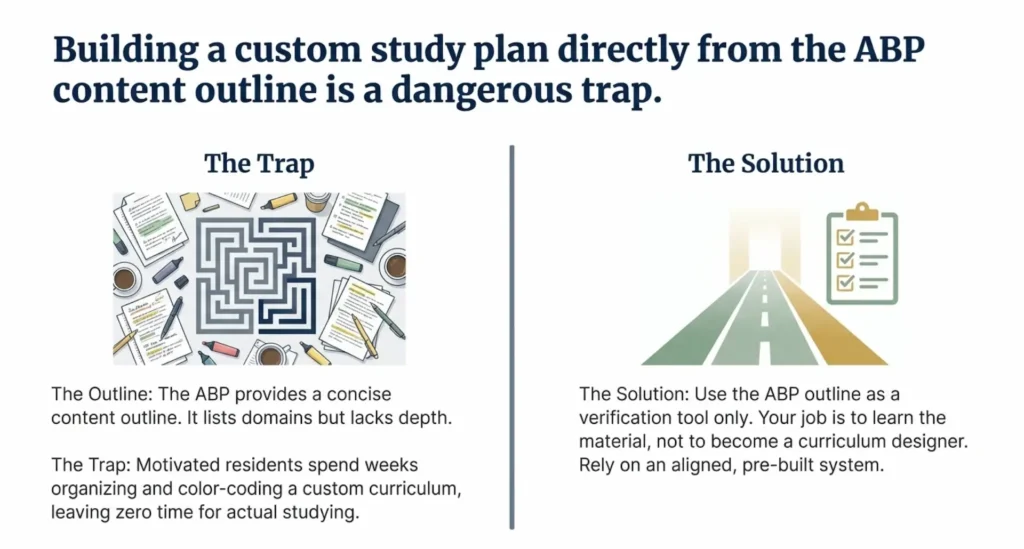
No. The content outline should not be your primary study roadmap. It’s too broad and requires excessive independent interpretation. Attempting to build your own study plan directly from the outline often leads to inefficiency and missed gaps.
Instead, use the content outline as a verification tool. Confirm that your chosen board review system aligns with it. Then follow a structured study system rather than reinventing one from scratch.
What Is the Most Effective Way to Prepare for the Pediatric Board Exam?
The most effective preparation strategy is structured, systematic, and aligned. Here’s what that actually means in practice.
Choose an Aligned Board Review Resource
Your board review should:
- Align closely with the ABP content outline
- Provide depth beyond surface bullet points
- Use repetition and reinforcement
- Integrate clinical reasoning with foundational knowledge
To explore structured options, visit our Initial Certification review courses.
Follow the System, Don’t Build Your Own from Scratch
I see this all the time. A motivated resident decides they’re going to build their own study plan from the ABP content outline. They spend weeks organizing, color coding, and planning their plan. And then they run out of time for the actual studying.
Don’t do this. A good board review system has already done the alignment work for you. Follow it. Trust the structure. Your job is to learn the material, not to become a curriculum designer.
How Many Hours Should You Study?
PBR recommends a minimum of 300 study hours for low risk candidates and 500 hours for those at higher risk. That includes time for content review, test taking strategy, and timed practice.
Not sure where you fall? Use our Risk Calculator on the Initial Certification page to get a personalized study plan based on your risk profile.
Emphasize Foundational Knowledge
The exam rewards strong foundational understanding across general pediatrics. Preparation should focus on mastering core systems rather than memorizing isolated facts. Know why things happen, not just what happens.
Practice Questions and Mock Exams: How to Use Them Correctly
Practice questions are valuable but only when used correctly. They should not be your primary learning source.
Appropriate Uses of Practice Questions
They should be used to:
- Gauge your knowledge in specific pediatric domains
- Identify weak areas that require deeper review
- Practice answering in a timed environment
- Develop familiarity with board style question phrasing
Answering questions under time pressure is a distinct skill from practicing pediatrics. That skill must be trained.
What Practice Questions Should Not Replace
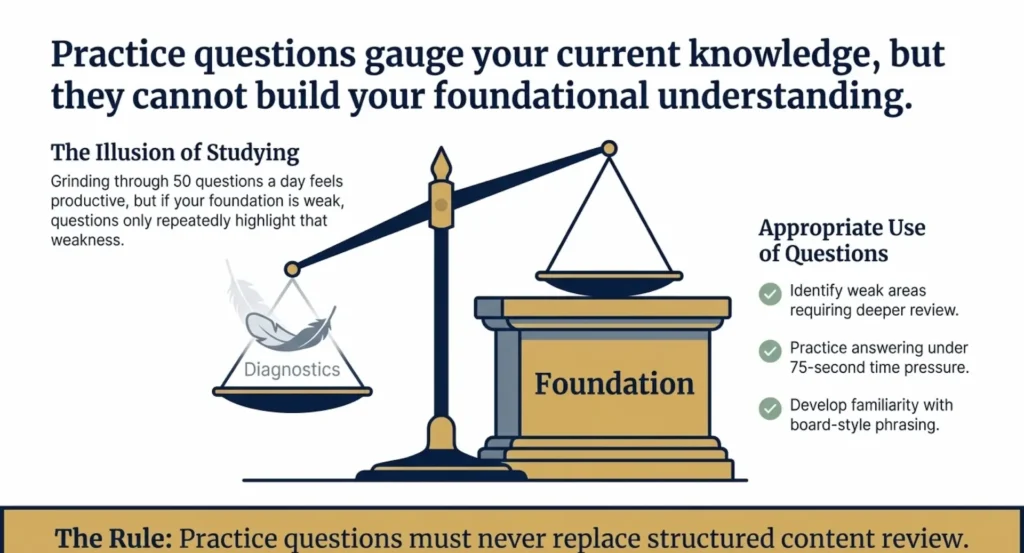
They should not replace structured content review. This one hurts because it’s so common. You buy a question bank, start grinding through 50 questions a day, and you feel like you’re studying. But questions test what you know. They don’t build what you don’t know.
If your foundation is weak, doing more questions just shows you, over and over, that it’s weak.
We wrote a whole piece on this: Why Prep Questions Aren’t the Best Study Questions it’s worth reading before you start your prep.
Common Pitfalls in Pediatric Board Exam Preparation
Candidates who struggle with the pediatric board exam tend to make the same mistakes. Sound familiar? Here they are so you can avoid them.
1. Over Reliance on Questions
Using questions as a primary study tool leads to shallow learning. Questions test knowledge, they don’t build it. We see candidates who’ve done thousands of questions and still fail because their conceptual foundation was never solid.
2. Passive Review
Reading without engagement, repetition, or integration results in low retention. If you can’t explain it back in your own words, you don’t own it yet.
3. Ignoring Weak Systems
Avoiding difficult domains may feel comfortable, but it creates risk on exam day. Weak systems must be identified and strengthened early not the week before the exam.
4. Poor Time Management Preparation
Failing to practice under timed conditions leads to unnecessary stress and rushed decision making. If you haven’t trained your pacing, the clock becomes your enemy.
5. Lack of Structure
Unstructured studying creates gaps and inefficiencies. A consistent, organized system reduces cognitive load and improves retention. Scattered notes and random resources rarely get you there.
Pro tip: Candidates who’ve previously struggled often benefit most from identifying which of these five pitfalls hit them hardest and addressing it head on in their next attempt.
If you’ve already sat for the exam and didn’t pass, see our failed boards recovery guide and our structured study plan for retakers.
Pediatric Board Exam Results: Release Timing and What to Expect
The pediatric board exam is scored on a pass/fail basis using a standardized methodology established by the certifying body.
When Are Results Released?
Results are typically released approximately six to eight weeks after the final day of the exam window. The ABP publishes the expected release date on their website, so you don’t have to guess. Historically, this has placed results in late October each year.
| Year | Approximate Release Window | Notes |
| 2023 | Late October | Standard release pattern |
| 2024 | Late October | Similar timeline |
| 2025 | Late October | Consistent trend |
| 2026 | Expected Late October | Based on prior patterns |
Tracking historical patterns helps candidates manage expectations and reduce unnecessary anxiety during the waiting period.
For the most current release timing, check our annually updated page: Pediatric Board Exam Results 2025.
Important: This results guide is updated annually. When the calendar year changes, URLs and internal links should be updated directly rather than creating redirect chains to preserve SEO integrity.
Should You Take a Pediatric Board Review Course?
For most candidates, yes, but the value depends entirely on the course.
A strong pediatric board review course should:
- Align with the ABP content outline
- Provide depth beyond minimal descriptions
- Use structured repetition
- Teach test taking strategy, not just content
- Offer multi modal learning when appropriate
A well designed course reduces guesswork, improves efficiency, and builds confidence for exam day. And here’s the thing, not all courses are built the same way.
PBR’s 400 page study guide, the VAPP (Virtual Atlas of Pediatric Pictures), the Live Test Taking Strategies course, and the VIP Bundle, including anxiety management tools are all built specifically around how the ABP actually tests. Candidates who use PBR are more likely to pass than the general test taking population.
Final Thoughts and Next Steps
The pediatric board exam represents more than a test. It’s the formal transition into fully credentialed pediatric practice. And it’s worth treating it that way.
Preparation should be intentional and structured. Relying on scattered resources, unstructured notes, or excessive question drilling is rarely sufficient. Instead:
- Choose a board review resource aligned with the content outline
- Follow a structured study system
- Use practice questions strategically
- Address weak areas early
- Train pacing before exam day
Board certification protects your career, expands your options, and affirms your professional identity. Approach preparation with the same seriousness and clarity that you bring to patient care.
With the right strategy and structure, success isn’t a matter of luck, it’s the natural outcome of disciplined preparation.
Take the Next Step Toward Board Certification
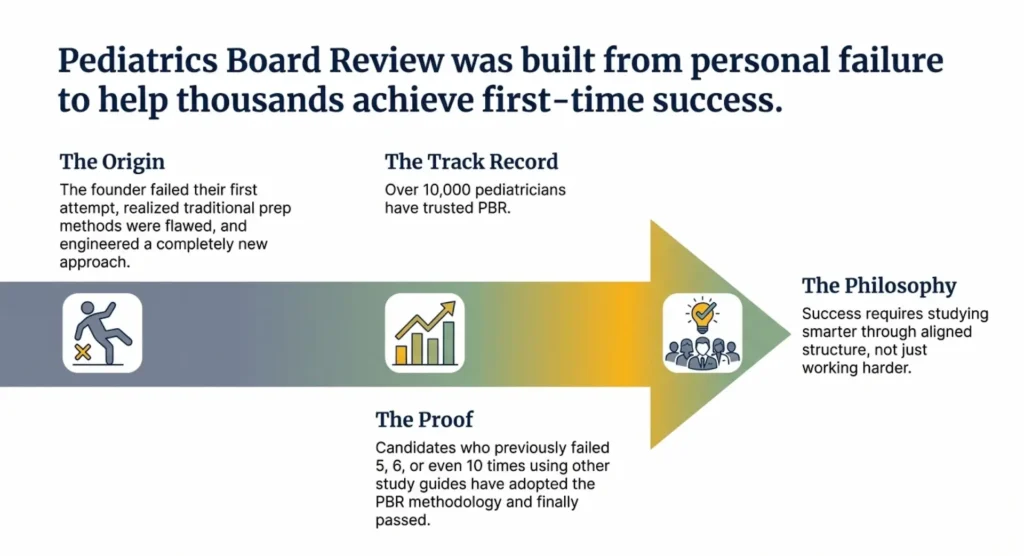
I failed my first attempt. I know exactly how that feels. That’s why I built PBR and why over 10,000 pediatricians have trusted it to prepare for the boards.
Candidates who’ve failed 5, 6, even 10 times with other study guides have come to PBR and passed. That’s not marketing. That’s what happens when you study smarter, not just harder.
Here’s what makes PBR different:
- ABP aligned 400 page Core Study Guide concise, high yield, built for retention
- Live Test Taking Strategies course because knowing the content isn’t enough
- VAPP, Virtual Atlas of Pediatric Pictures
- Multimodal learning: print, video, audio, and digital
- Structured study schedules for every risk profile
- 100% Money Back First Time Pass Guarantee
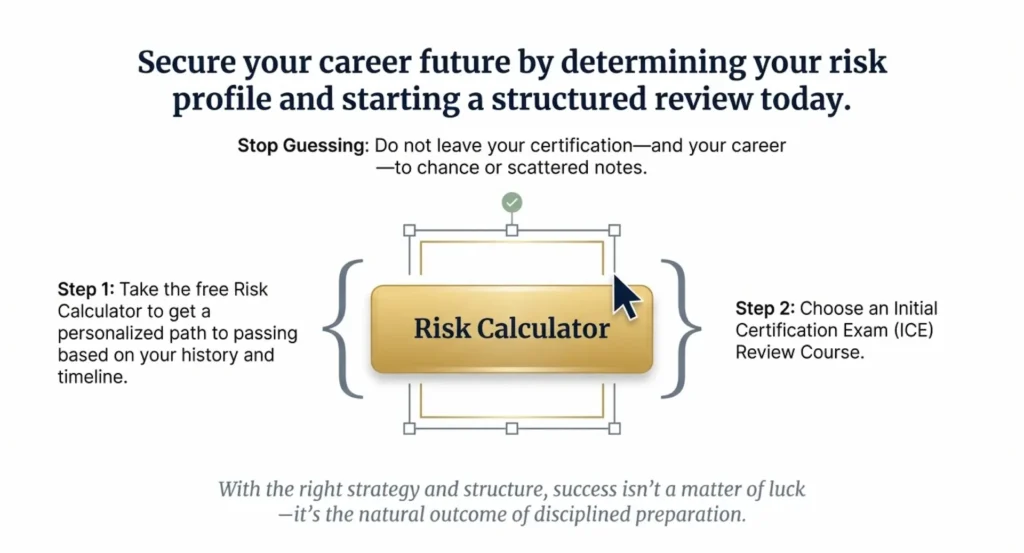
Not sure where to start? Take the free Risk Calculator and get a personalized path to passing based on your timeline, your risk level, and your history.
Explore our ICE Review Courses | Browse All Products
FAQs
1. How hard is the Pediatric Board Exam?
The exam is comprehensive but fair. It focuses on core pediatric knowledge and clinical reasoning, not obscure trivia. That said, the breadth of material can feel overwhelming if you don’t have a system. Candidates who follow a structured review plan and practice under timed conditions tend to do well. PBR recommends a minimum of 300 study hours for low risk candidates and 500 hours for those at higher risk including time for content review, test taking strategy, and timed practice. Candidates who prepare systematically pass at higher rates than the general population.
2. How many questions are on the Pediatric Board Exam?
The exam is divided into four timed blocks with approximately 84 questions each, for a total of roughly 330–350 questions. The total question count may vary slightly by year. Each block runs 1 hour 45 minutes, and the total exam day is approximately 8.5–9 hours including breaks. Pacing around 75 seconds per question matters as much as knowledge.
3. What is the best way to study for the Pediatric Board Exam?
Use a structured board review program aligned with the ABP content outline and follow a consistent study schedule. Focus on mastering foundational systems rather than memorizing isolated facts. Use practice questions to identify and correct weak areas, not as your primary learning tool. PBR recommends 300–500 hours of total prep time depending on your risk profile. Our Risk Calculator on the Initial Certification page can help you build a personalized plan.
4. When is the Pediatric Board Exam offered?
The exam is typically offered over a three day window in mid October, Tuesday, Wednesday, or Thursday. Candidates select their test date during registration. The exam is held at Prometric testing centers nationwide. Register early, as preferred dates and locations fill up quickly.
5. When are Pediatric Board Exam results released?
Results are typically released approximately six to eight weeks after the final day of the exam window; historically, this places results in late October. The ABP posts the expected release date on their website. Candidates receive electronic notification and may also receive general domain level feedback to guide future preparation if needed.
6. What is the pass rate for the Pediatric Board Exam?
Pass rates have generally ranged from the low to mid 80s since the ABP updated its scoring methodology in 2012. The typical rate is approximately 84%, though some years have reached 90–91%. Prior to 2012, pass rates were in the high 70s. The exam is no longer curve based, in theory, every candidate can pass by correctly answering a sufficient number of questions.
7. What happens if I fail the Pediatric Board Exam?
You can retake the exam during a future administration after meeting eligibility requirements. Most candidates improve significantly by strengthening weak systems, improving time management, and following a more structured study plan. PBR has helped candidates pass after failing 9 and 10 times. If you’ve already failed, don’t wing your next attempt use a structured recovery plan.See our Failed Boards Recovery Guide for a step by step approach to your next attempt.