

When I sat for my own boards the year I finished residency, I walked out feeling sick, convinced I might have failed. I had studied as if I needed to know everything about everything. I went deeper into certain topics than the ABP was ever going to ask, chasing nuances that question banks raised, even trying to memorize exact medication regimens and dosages.
What eventually turned my score around wasn’t studying more. It was studying at the right depth and realizing that I had been approaching board review questions all wrong. I had been reading almost every question as if it simply asked, “what would you do next,” instead of slowing down to read the exact words the question writer chose and critically thinking about what each of those words was there to test. Once I learned to study at the depth expected by general pediatric practice and the ABP, and I learned to read a question for what it was truly asking, my score rose by more than 40%, I scored well above the national average, and I was even asked by the ABP to write questions for them.
Preparing for the ABP Initial Certification Exam takes more than memorizing facts. It takes a structured approach to content, a system for translating that content into exam performance, and the discipline to follow through. Pediatric board review questions play a specific and essential role in that preparation, but only when you understand what they are actually for and how to use them effectively alongside your core content review.
This guide explains how to build a study system around board-style practice questions so they serve you in the ways that matter most, from self-assessment and reinforcement to test-taking strategy, stamina, and readiness. The principles here are grounded in a methodology that I created, and it has helped more than 10,000 pediatricians.
Who This Guide Is For
| If You Are… | This Guide Will Help You… |
| A resident preparing for initial certification | Build a structured study plan that integrates content review and practice questions in the right sequence |
| A first-time taker building a study plan | Understand what board-style questions are actually for and how to choose the right question bank |
| A repeat taker looking for a better approach | Identify where your previous preparation may have gone wrong and how to fix the gaps |
| A busy pediatrician fitting prep into a demanding schedule | Prioritize what matters most and avoid wasting time on approaches that do not move the needle |
Content Is King: Why Your Study Guide Comes First
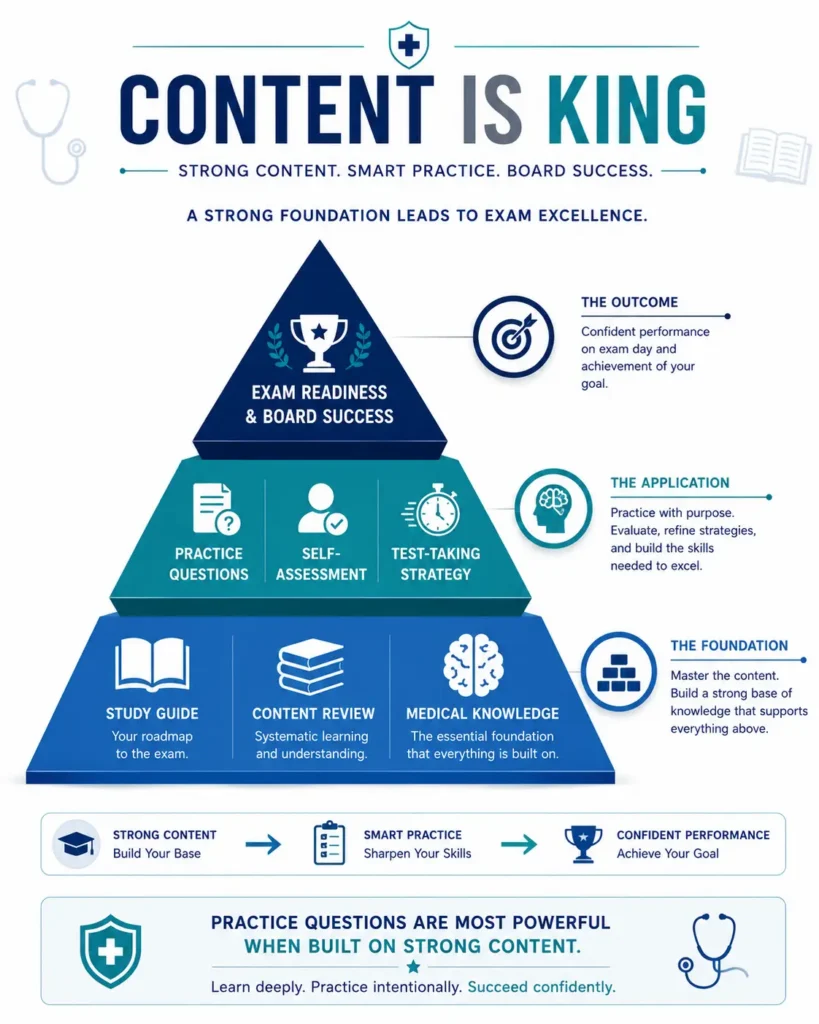
Before talking about practice questions, it is important to understand where they fit in the larger picture. Board exam preparation rests on the three pillars of Content (medical knowledge), Test-Taking Strategy (translating knowledge into exam performance), and Commitment (discipline and follow-through).
When it comes to medical knowledge, content is king. The foundation of your preparation is organized, systematic content review using a trusted study guide. A comprehensive study guide presents pediatric medicine the way you need to learn it, chapter by chapter, system by system, with the depth and breadth that matches what the American Board of Pediatrics expects.
Practice questions cannot replace that foundation. Questions in a board-style question bank are randomized by design because they are built to simulate the exam experience. When you review question explanations, you are jumping from cardiology to infectious disease to adolescent medicine with no chapter or system context. You can learn something from a well-written question explanation, but you will not gain the comprehensive understanding of fundamental pediatric knowledge needed for the exam and for clinical practice by going through questions alone.
No question bank is exhaustive. Every question bank has limits on what it covers. If you rely on questions to learn content, you will have gaps. A study guide built around the ABP content outline does not have those gaps.
Start with your study guide. Build the knowledge base first. Then layer practice questions on top for the purposes they actually serve.
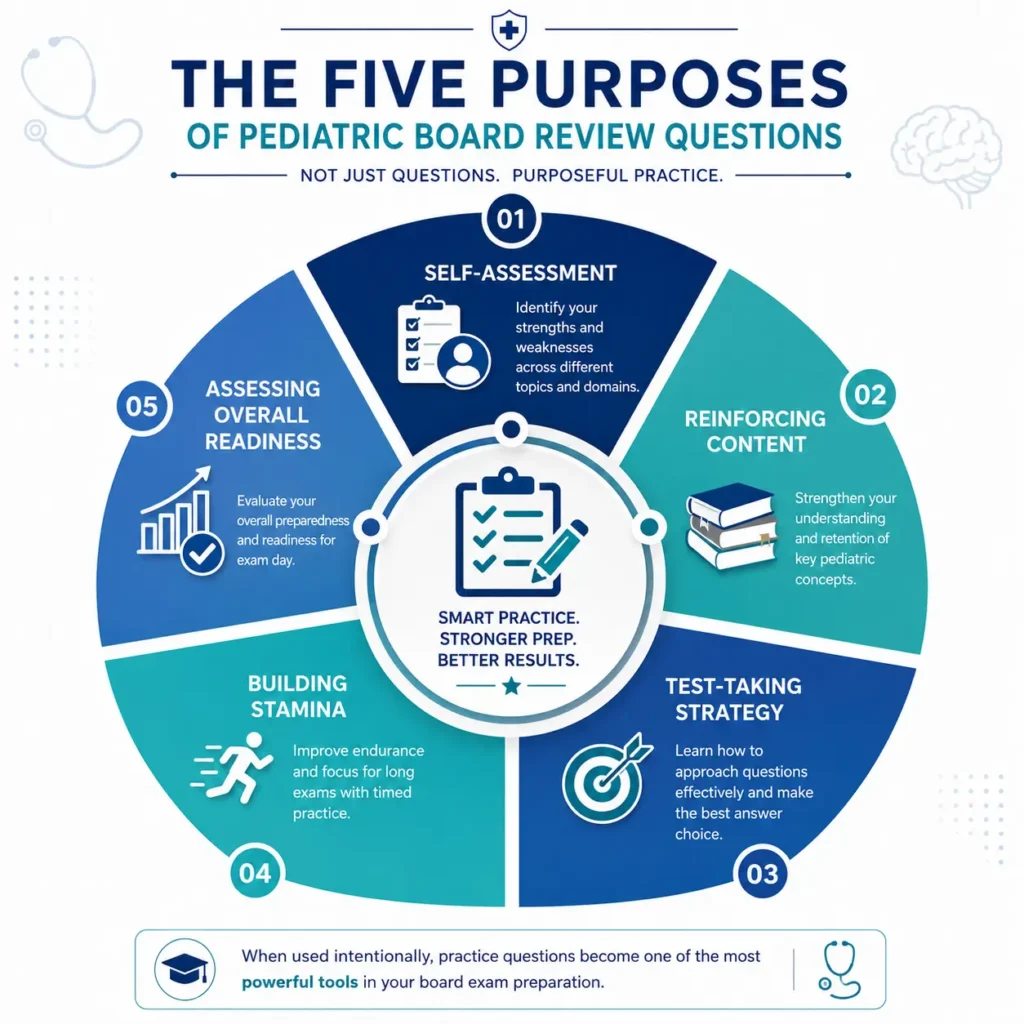
The Five Purposes of Pediatric Board Review Questions
1. Self-Assessment After Content Review
After you finish a chapter or system in your study guide, practice questions are an excellent way to test yourself. How well did you retain the concepts? Can you recognize them when presented in a clinical scenario? This is using questions to measure what you learned, not to do the learning itself.
The difference matters. If you score poorly on cardiology questions after studying the cardiology chapter, that tells you something actionable. You need to go back and review. If you are doing questions without studying the content first, a poor score tells you very little, because you never had the foundation to begin with.
Treat it as an early check, not a final verdict on your readiness. Doing questions right after a chapter tends to make your score look great, which points to a second, separate benefit.
2. Reinforcing the Content So It Sticks
Pulling an answer out of your own head is very different from rereading a chapter you just covered. The act of retrieving what you just studied strengthens the memory far more than passive review. That’s why working through questions right after you read a chapter can be worth doing, even when you already feel like you know the material.
Used this way, questions are a way to lock in what you have learned so it’s still there weeks later. But remember, since you just read the chapter, these scores will look better than your true readiness for the exam, so use them to reinforce and retain, not to judge whether you’re ready. That judgment comes from a different kind of practice, which we will get to.
3. Turning Knowledge into Exam Performance (Test-Taking Strategy)
There is a real difference between knowing the medicine and being able to show it on a board exam. You might understand neonatal sepsis cold and still choose the wrong next step under time pressure. That gap, between what you know and what your score reflects, is what test-taking strategy is built to close.
Sometimes pediatricians know the content but still miss questions. They describe getting it “down to two answer choices” and then picking the wrong one. This is frequently a strategy gap, not a knowledge gap.
What’s actually happening in many of these cases is that the test-taker does not fully understand what the question writer is intending to ask. Once you learn to decipher that intent, you often realize that one of the two answer choices you were debating does not even align with what was being asked. The “down to two” problem resolves, and you can demonstrate the knowledge you actually have.
Test-taking strategy is not about gaming the exam and trying to shortcut your way to a passing score. It’s about understanding what the exam is trying to test you on and learning to move through each question systematically so that your hard work, your studying, and your clinical knowledge translate into a score that matches.
Many pediatricians describe a common pattern. They do well in clinical practice, they may even have received recognition or awards during training for clinical excellence, but their board scores never reflect what they know. That disconnect is real, and it’s exactly what test-taking strategy is designed to bridge.
When it clicks, pediatricians describe it as an “aha” moment. The exam questions start making sense in a different way. The clinical confidence they feel finally matches the scores they receive. This is not about learning tricks. It is about learning to read questions the way the question writer intended them to be read.
I learned this the slow way. For a long time I read almost every question as if it were only asking “what would you do next,” until I started paying attention to the exact words the writer chose and what each one was there to test. The Monday after one of my live Test-Taking Strategies courses, a physician even told me her practice scores had jumped about 20 percent almost overnight. While individual results may vary, this shows what can shift once the strategy clicks. She had always felt like a strong clinician whose scores never matched what she knew. Once she could see what each question was really asking, that gap closed, and she went on to pass.
If you go through practice questions and feel like you knew the content but still missed the question, you’ll likely benefit from structured test-taking strategy training. The questions become a diagnostic tool for identifying that gap.
4. Building Stamina and Time Management Through Mock Exams
The ABP Initial Certification Exam is approximately 340 questions across four blocks, with roughly 75 seconds per question. That is a long day of high-stakes cognitive work.
Practice questions, especially full-length mock exams, help you build the stamina to perform at a high level across multiple blocks. Can you maintain focus and accuracy from the first question of block one through the last question of block four? Can you finish within the time constraints without rushing through the final questions?
These are not questions of your knowledge. They’re endurance and pacing questions, and the only way to answer them, introspect, and learn how to adjust your exam-day experience is through structured practice under realistic conditions.
5. Assessing Overall Readiness
When you use a high-quality question bank that is genuinely aligned with the ABP content outline, your overall performance becomes a meaningful signal of how ready you are. The key word is overall. It’s not about any single domain on any single test. Readiness shows up in the whole picture, your total score across a full and randomized set of questions, your pacing, and your stamina.
Be careful about reading too much into one domain on one mock exam. A single mock includes only a handful of questions per content area, so a weak score in one section is often noise rather than a real gap. The signal you can trust comes from a large body of questions pointing the same way, your chapter-by-chapter results combined with full-length mocks. When both say the same thing, believe them. That combined picture, along with your timing and confidence, is what you use to calibrate your final weeks.
How to Build a Study Plan Around Pediatric Board Exam Questions
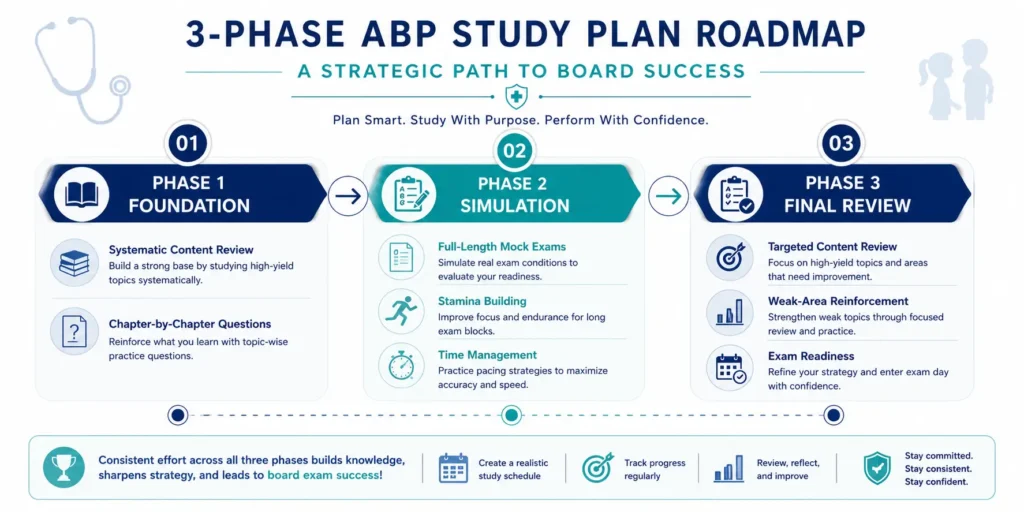
Understanding the purposes of practice questions helps you place them correctly in your study timeline. Here is a phased approach that keeps content first and questions in their proper role.
| Phase | Primary Focus | Question Role | Question Volume |
| 1. Foundation | Systematic content review (study guide) | Self-assessment after each chapter (go through all chapter-aligned questions) | Chapter-specific sets |
| 2. Simulation | Mock exams and stamina building | Full-length timed blocks for readiness assessment | Exam-length sessions (340 questions) |
| 3. Final Review | Targeted review of persistent gaps | Return to content, not new questions | Minimal (focus on content sharpening) |
Phase 1: Foundation (Content Review and Self-Assessment)
This is where you spend the majority of your preparation time. Work through your study guide systematically, chapter by chapter, system by system. Use active study methods such as highlighting, taking notes, and self-testing on the concepts as you go.
After completing each chapter in your study guide, go through the corresponding questions in your question bank for that topic. If your question bank is built by the same company that produces your study guide, these questions are designed to align with the content you just reviewed. Go through all of them. This serves Purpose 1 (self-assessment) and also begins building your familiarity with how board-style questions are constructed.
This means that by the time you complete your full pass through the study guide, you will have also completed the full question bank, chapter by chapter. That is by design. The questions are not a separate resource you save for later. They are the self-assessment layer that runs alongside your content review.
For each question you miss during this phase, ask yourself two things. Was this a content gap or a strategy gap? If you did not know the medicine, go back to the chapter and review that specific topic. If you knew the content but misread the question or missed what the question writer was asking, note that as a strategy gap to address.
Phase 2: Simulation (Mock Exams and Stamina)
Once you have completed your study guide and question bank, shift to full-length mock exams (Purpose 4). Simulate real exam conditions with four timed blocks and no interruptions. This builds the stamina and time management skills you need for exam day.
After each mock exam, look first at the whole picture, your total score, your pacing, and how your stamina held up across four blocks. A mock exam is really there to teach you how you move through a long exam day and what to adjust in your routine, your morning prep, your food, your caffeine, and more so that you arrive as the most optimized version of yourself.
Be careful about drawing conclusions from any single domain. A properly structured mock exam will only include about ten to fifteen questions per content area even in the larger content domains, which is far too few to judge how ready you are in that domain. A real domain-level assessment would take a hundred or more questions in that area alone.
One important note about mock exam data. If your question bank contains approximately 2,200 questions and your mock exam uses 340 of them, the sample size for any individual topic area within that mock exam is relatively small. A poor score in one section of one mock exam does not necessarily mean you have a gap in that area. However, when you combine the data from your chapter-by-chapter question bank results with your mock exam performance, and as long as those question sets are unique, you have a much larger dataset that gives you more reliable insight into where your true strengths and weaknesses are.
Phase 3: Final Review
In the last days before the exam, return to your study guide for a targeted review of persistent trouble spots. This is not the time to do hundreds of new questions. Your knowledge base is built. Your strategy skills are practiced. Now you are sharpening the edges and reinforcing the content that has been most difficult to retain.
The proximity of your final content review to the exam matters. Material reviewed months ago fades. Material reviewed in the final week is fresh. Content is king, and this phase is about making sure your strongest content review is also your most recent.
How to Pick a Good Pediatric Board Review Question Bank
Not all question banks are created equal. The right question bank makes your practice time meaningful. The wrong one wastes it or, worse, gives you a false sense of readiness. Here is what to evaluate.
ABP Content Outline Alignment. The ABP publishes a content outline
(content specifications) for the Initial Certification Exam. A high-quality question bank is built around that outline. If a question bank does not reference or align with the ABP content outline, its coverage may not match what you will see on exam day.
Companion Study Resources. Does the company also offer a study guide? If a company sells a question bank but does not offer a content resource, ask why. A company that does not produce a study guide may be building questions from a knowledge base that is not necessarily aligned with what the ABP expects. Their questions may cater more broadly to pediatricians and medical students rather than specifically to ABP exam candidates.
Question Style and Focus. The ABP focuses on clinical application, diagnosis, and management. If you are seeing a lot of basic science and pathophysiology questions in a question bank, that bank may not be well-aligned with the ABP exam. Your time is better spent on a resource that mirrors what the ABP actually asks.
Audience Specificity. Some question banks market to both medical students and board candidates. The ABP exam is specific in scope and style. A question bank that tries to serve medical students, pediatric residents, and board candidates with the same question set may not be optimized for any of those audiences. Look for a resource built specifically for the ABP exam.
Pediatrics Board Review is trusted by 10,000+ pediatricians at programs including Johns Hopkins, Mayo Clinic, and Cleveland Clinic. It is built around exactly this approach. Every question in the PBR question bank maps to a companion flashcard for reinforced learning, and every question explanation includes a test-taking strategy count showing how many strategies could have applied for systematic processing of questions. PBR also offers a 100% Money Back First-Time Pass Guarantee because we know the system is designed to work.
Applying that checklist to PBR is straightforward enough to do yourself: see how the explanations handle wrong answers, then judge it against the criteria above.
What About Free ABP Practice Questions?
Transparency builds trust, so let us talk about what is available at no cost.
The ABP offers free self-assessment question sets through its portfolio system. These are listed under Maintenance of Certification (MOC) as “Self-Assessment (Part 2)” activities. To find them, log in to your ABP Portfolio, navigate to the MOC section, click “Search Activities,” then “Self-Assessment (Part 2) Search,” and filter by the sponsor “American Board of Pediatrics.” You can also navigate directly through cont-certification.abp.org.
Residents and fellows who are not yet certified can access ABP-developed Self-Assessment Part 2 activities during training, though they do not receive MOC points at that stage.
What is currently available changes over time. Historically, the ABP has offered various batches of free self-assessment questions. As of this writing, there are sets of 25 Infectious Disease questions and 25 Adolescent Medicine questions, along with various “Decision Skills” self-assessments. The specific offerings may appear, disappear, or be renamed, so check the ABP Portfolio directly for the most current options.
These free resources have genuine value for what they are designed to do, which is self-assessment on specific topics. They can help you gauge your understanding of a particular content area (Purpose 1 from above) and give you an opportunity to understand the structure and “personality” of ABP questions.
What they cannot do is provide the volume, ABP-aligned scope, or structured practice environment that a dedicated question bank provides. A set of 25 Infectious Disease questions can help you self-assess on that topic, but it cannot build exam-day stamina across 340 questions (Purpose 4), assess your overall readiness across all ABP content areas (Purpose 5), or help you identify strategy gaps that span the breadth of the exam (Purpose 3).
Think of it this way. The ABP’s free self-assessment questions are a useful spot-check. A dedicated question bank is the structured training environment. For a structured practice environment aligned to the full ABP content outline, explore PBR’s question bank.
The ABP Content Outline: Your Study Roadmap
The ABP content outline is the authoritative source for what the exam covers, and understanding its structure helps you allocate your study time wisely. The content outline tells you exactly what the ABP considers in-scope, which helps you evaluate whether your resources are covering the right material.
Every topic area on the content outline matters. The ABP assigns different weights to different domains, which can help you understand the relative emphasis on the exam. But this does not mean lower-weight topics can be ignored. Any topic on the content outline can appear on your exam, and the questions you encounter will require clinical reasoning regardless of the domain.
The ABP content outline is available on their website (abp.org). Review it before you start studying. It provides a clear picture of what the ABP expects and serves as a benchmark for evaluating any study resource you are considering.
Strong clinical practice and board exam success overlap more than most people realize. The knowledge the ABP expects is the same knowledge that makes a pediatrician effective in daily practice. You are not studying for an arbitrary test. You are deepening the expertise that serves your patients. A strong study guide built around the ABP content outline covers all of these areas in the depth the exam expects.
Understanding ABP Question Types
The ABP exam uses several question formats, and recognizing them quickly helps you process questions more efficiently.
| Question Type | What It Looks Like | What It Tests |
| Single Best Answer | A clinical vignette asking for the most appropriate next step, or a standalone question with answer choices and no vignette (the standalone format tends to be more fact-based than clinical reasoning) | Clinical reasoning and application |
| Diagnosis | A clinical presentation, sometimes with lab or imaging data. Not all diagnosis questions include labs, images, or EKGs, and these have been reported to be found less often in recent years | Pattern recognition and the ability to confidently reach a diagnosis, not only build a differential |
| Management | A patient scenario asking for the single best next step, which may be a treatment, a diagnostic test, a referral, or a specific exam, not only treatment | Clinical judgment about the single right next action |
| Prevention & Screening | Well-child visit or risk assessment scenario | Preventive care and screening recommendations |
Each question type has specific patterns in how it is structured and what the question writer is asking you to demonstrate. Learning to recognize these patterns, and understanding the intent behind the question, is part of the strategy skill that practice questions help develop (Purpose 3).
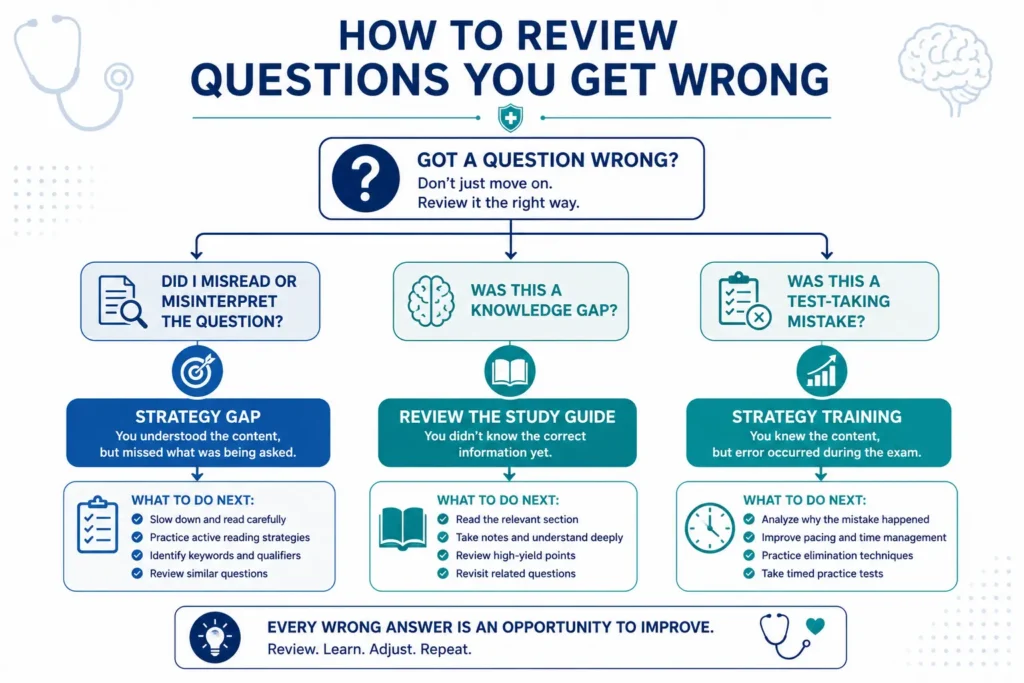
How to Review Questions You Get Wrong
How you review missed questions matters as much as how many questions you do. A systematic review process turns every wrong answer into actionable information.
For each question you miss, ask yourself three things.
Did I misinterpret something? Sometimes the issue is not what you know but how you read the question. You may have focused on the wrong detail in the vignette, or you may have missed what the question writer was actually asking or failed to concept map correctly. This is a strategy gap, and recognizing the pattern helps you avoid it on future questions.
Was this a knowledge gap? If you did not know the medical content, the next question is whether it is a knowledge gap your study guide covers. If your study guide addresses the topic, go back and review it. That is the kind of gap worth spending time on.
If the question tested something esoteric, something that would typically be solved with a quick reference in clinical practice rather than expected knowledge for a board-certified pediatrician, do not spend excessive time on it. Stay anchored to your study guide.
Was this a strategic mistake? Did you know the content but get tripped up by the question structure? Did you get “down to two” and pick the one that did not align with the question writer’s intent? If so, that is a pattern worth tracking. It tells you that test-taking strategy work may help you translate the knowledge you already have into correct answers.
Common strategic mistakes to watch for
If several of your misses land here, that’s a strategy gap, not a knowledge gap. The most common ones include the following.
- Not truly understanding what the question writer intended to ask.
- Failing to concept-map the case appropriately.
- Fixating on one symptom while overlooking others that would help separate the right answer from the wrong ones.
- Not reading every answer choice to find the single best one.
- Inserting outside knowledge beyond what the question actually provides.
Leaning on what you do in clinical practice instead of the guidelines and recommendations of the exam tests.
Spotting which of these trips you up is exactly what structured test-taking strategy training is built to fix. It teaches you to read a question for what the writer is actually asking, so the knowledge you already have shows up in your score.
➤ See how PBR’s test-taking strategy training works.
The goal of question review is not to read every word of every explanation. Some question bank explanations are extremely detailed, diving into research and clinical nuances that go well beyond what the ABP expects. That level of detail can create an information bloat that pulls you away from your core study guide. Focus on understanding why you got it wrong, categorize the miss, and take the appropriate next step.
How Many Questions Should You Do?
There is no magic number, but the structure matters more than the count.
If your question bank is aligned with your study guide and built by the same company, the natural approach is to go through all the questions for each chapter after you complete your content review in that area. This is not about rushing through volume. It is about using every question as a self-assessment tool tied directly to the content you just studied.
If you are using a separate question bank that is not aligned with your primary study guide, be more selective. Use it for targeted review or to practice identifying question writer intent, but do not feel compelled to work through every question in a bank that may contain pathophysiology, basic science, or content that does not match the ABP’s expectations. A question bank that is not aligned with your study guide can introduce information bloat, pulling your attention toward material that is not going to appear on the exam the way your study guide presents it.
During the simulation phase, shift to full-length timed blocks and mock exams. Simulate the real exam as closely as possible. Analyze performance by topic area, keeping in mind the sample size considerations discussed above.
Comparing ABP Question Banks
When evaluating question banks, focus on verifiable facts rather than marketing claims. Here are the key details to consider.
| Question Bank | Question Count | Access Period | Price Range | Companion Study Guide? | Flashcards Per Question? | Notes |
| AAP PREP | 200 | 3 years | $350 to $600 (member to non-member) | No | No | AAP transitioned from the legacy ~260 per year PREP Self-Assessment to modular PREP Blocks in 2026. Membership provides 10 blocks of 20 case-based questions each. |
| TrueLearn | 1,350+ | 30 / 90 / 180 / 365 days | $209 to $469 | No | No | Flashcards are user-created, not pre-made. |
| BoardVitals | 1,700+ | 1 / 3 / 6 months | $199 / $299 / $499 | No | No | |
| MedStudy® | 2,000+ | 1 year | $449 | Yes (MedStudy Pediatrics Core Curriculum, sold separately) | No | MedStudy sells a separate flashcard deck (1,000+ cards), but the cards are not paired 1:1 with specific question-bank questions. |
| PBR | 2,158 | 1 year | $298.50 (with Flashcard Bundle) or $397 | Yes (PBR Core Study Guide, sold separately) | Yes (2,158 flashcards paired 1:1 with each question) | Every question is paired 1:1 with a companion flashcard. Includes a full-length mock exam that mirrors the ABP’s timing and format. Flashcards are available separately or as a bundle. |
Sources: each provider’s official website (aap.org, truelearn.com, boardvitals.com, medstudy.com, pediatricsboardreview.com), verified at time of writing. Question counts and prices change frequently; confirm current figures on each provider’s site.
Companion Study Guide. This article makes the case that your question bank should be aligned with your study guide. PBR offers both, built as an integrated system. If a company sells a question bank but does not produce a study guide, the questions may not be built around a structured content foundation aligned with the ABP content outline.
Companion Flashcard per Question. PBR is the only question bank where every question maps to a companion flashcard. After you review a question explanation, you have a corresponding flashcard for spaced repetition on that concept. The question bank and flashcard bank work as an integrated system. (Flashcards are sold separately.)
Test-Taking Strategy Count. Every PBR question explanation includes a line stating “Minimum number of test-taking strategies: X,” where X is the number of strategies that could have applied to process that question systematically based on the information presented. This does not teach the strategies themselves (that happens through PBR’s separate courses), but it tells you exactly how much strategic support was available for each question.
ABP-Aligned Mock Exam. PBR’s mock exam replicates the real ABP exam experience, with a tutorial, timed blocks, and breaks at the appropriate intervals. This is different from a basic timed quiz. It is designed to build the specific stamina and pacing skills you need for exam day (Purpose 4). In addition to a comprehensive question bank covering all ABP Content Outline domains, PBR offers you the option to create a complete mock exam that mirrors the actual ABP initial certification exam with a tutorial, breaks, and block times that match the exam.
➤ Ready to see PBR’s question bank in action? Explore the PBR question bank.
Ready to Build a Repeatable ABP Study System?
Board preparation works best as a system, not a collection of scattered efforts. The right study guide builds your content foundation. The right question bank measures your progress, sharpens your strategy, and tests your readiness. The right approach to commitment makes sure you actually follow through.
Pediatrics Board Review has helped more than 10,000 pediatricians at institutions including Johns Hopkins, Mayo Clinic, and Cleveland Clinic build exactly this kind of system. The PBR Initial Certification course includes five core elements.
- A comprehensive study guide aligned with the ABP content outline
- A question bank where every question maps to a companion flashcard
- Test-taking strategy counts in every question explanation
- An ABP-aligned mock exam with tutorial, timed blocks, and appropriate breaks
- A 100% Money Back First-Time Pass Guarantee
About the Author
Dr. Ashish Goyal, MD, FAAP, is a board-certified pediatrician and the founder of Pediatrics Board Review (PBR). After his own experience with the ABP exam, he built a preparation system grounded in three pillars, comprehensive content review, test-taking strategy, and structured commitment. PBR has helped more than 10,000 pediatricians prepare for the ABP Initial Certification and MOC exams. Dr. Goyal teaches live test-taking strategy courses and oversees the development of all PBR study resources.
FAQs
How many questions are on the ABP Initial Certification Exam?
The ABP ICE consists of approximately 340 questions divided into four blocks. You have roughly 75 seconds per question. Understanding this structure helps you pace your practice sessions and mock exams to match real exam conditions.
When should I start doing practice questions?
Start doing questions after you build your knowledge base in a particular chapter of your study guide. If your question bank is aligned with your study guide, go through all the questions for that chapter while the content is fresh. This chapter-by-chapter approach means your question bank and study guide work together as one integrated system rather than two separate resources.
Can I pass the boards just by doing questions?
No question bank is exhaustive. Practice questions alone are unlikely to give you the comprehensive content foundation you need. The ABP tests across a wide scope that no single question bank can fully cover. Start with organized content review through a study guide, then use questions for self-assessment, strategy identification, and readiness testing.
How do I know if I am ready for the exam?
Take a full-length mock exam under timed conditions that mirror the ABP format. Your score, your pacing, and your confidence level across topic areas all provide data. Combine that with your chapter-by-chapter question bank results for a more complete picture. If you are consistently performing well across all major content areas, that is a strong readiness signal.
What is the difference between doing questions and doing a mock exam?
Chapter-by-chapter question practice is topic-specific and done alongside your content review. A mock exam replicates the full exam experience, with multiple timed blocks and appropriate breaks. Mock exams test stamina and time management in addition to content and strategy. Both serve different purposes, and both matter.
Should I use more than one question bank?
It depends on how your primary question bank is built. If your question bank is aligned with your study guide and covers the ABP content outline comprehensively, you may not need a second bank. Using a question bank that is not aligned with your core study resource can introduce information that goes beyond what the ABP expects, which can create confusion rather than clarity. The question is not how many banks you use, but whether your primary bank is aligned with your study guide and covers the full ABP content outline.
There’s also a secondary benefit to seeing questions from more than one bank. Exposure to the different “personalities” of question writers can prepare you for the range of approaches you’ll meet on the actual exam.
Are there free pediatric board review questions available?
The ABP offers free self-assessment question sets through its portfolio system. Check the MOC Self-Assessment (Part 2) section and filter by ABP as the sponsor. These are valuable for targeted self-assessment, though they do not provide the volume or structured practice environment of a dedicated board review question bank.
Keep learning: how much time you get per question, reading what each question is really asking, the formats ABP questions come in.